The outstanding Centaurus a (NGC 5128) galaxy: first light from Chile.
We present the first light of a new robotic unit we have in Chile: it shows the amazing Centaurus A galaxy (aka NGC 5128).
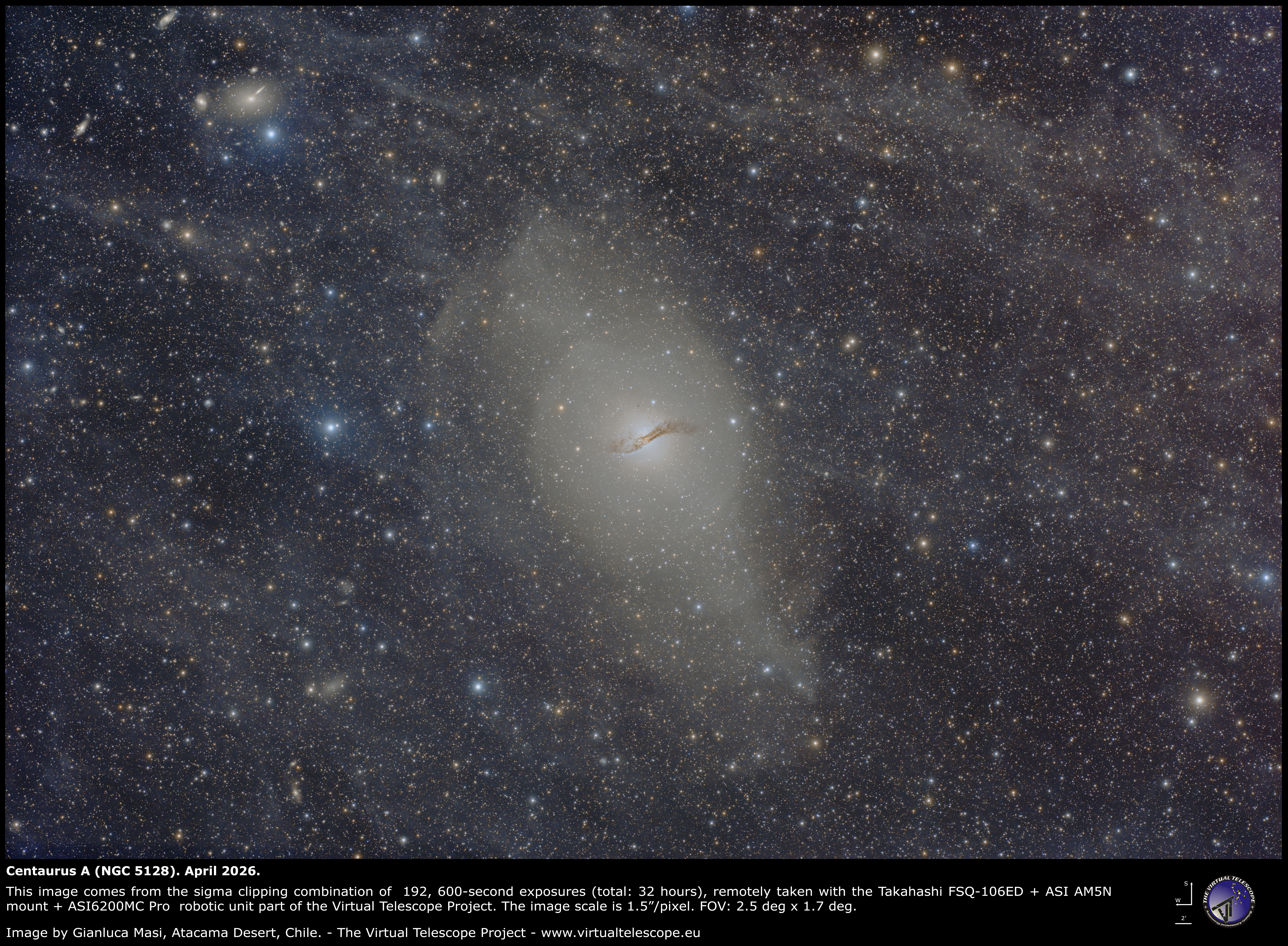
Centaurus A (NGC 5128)
It’s hard to hold back the emotion and satisfaction as I begin to write these lines, because they share with all of you a dream that has become reality.
I can finally announce that now the Virtual Telescope Project has full access to a telescope in Chile, under the purest sky on Earth, in the Atacama Desert.
It is an astrograph based on a Takahashi FSQ-106ED optical system, mounted on an ZWO AM5N harmonic mount, with a ZWO ASI2600MC Pro camera at the focus.
The instrument has been up and running for a couple of weeks (I thank Daniele Gasparri for the on-site assistance), it is shared with two other users and operates according to a program we have coordinated, while retaining the flexibility that is essential when dealing with the proverbial unpredictability of the sky.
In sharing this extraordinary milestone with you, I would like to present the first light of this unique jewel, capturing an iconic celestial object belonging to the southern sky: the famous galaxy NGC 5128, also known as Centaurus A.
The image above comes from a very long exposure, for a total of 32 hours of integration using this new Takahashi FSQ-106ED robotic unit we have in Chile.
Located about 12 million light-years from Earth, it represents an extraordinary cosmic laboratory for understanding the most energetic and complex processes in the universe.
NGC 5128 is immediately recognizable due to its unusual structure: an elliptical galaxy crossed by a thick dark band of dust. This feature is not merely aesthetic, but tells a violent story. Astronomers believe that Centaurus A is the result of a merger between an elliptical galaxy and a smaller spiral galaxy. The remnants of the latter are visible in the form of gas and dust clouds that cut across the bright nucleus.
At the center of NGC 5128 lies a supermassive black hole, with a mass nearly 60 million times that of the Sun.
Another interesting aspect of NGC 5128 is its intense star formation activity. Although it is classified as an elliptical galaxy, typically poor in new stars, the presence of gas and dust has triggered the birth of numerous star clusters. This phenomenon shows how galactic collisions can “reignite” otherwise quiescent regions, giving rise to new generations of stars.
NGC 5128 is an important radio galaxy, the closest one and belongs to the family of BL Lac objects, hosting an AGN (active galactic nucleus).
The extraordinary purity of the Atacama sky made it possible to capture the image presented here, where in addition to NGC 5128, visible in all its intriguing structure, one can notice faint “cirrus-like” features crossing the field of view. This is the so-called Integrated Flux Nebula (IFN), caused by gas and dust located outside the plane of the Milky Way and illuminated by its stars. A very elusive structure, clearly visible here also thanks to the remarkable integration time used, a full 32 hours, and the amazing, dark skies in the Atacama desert.
This first tribute to the beauty of the southern sky marks the beginning of a new chapter for the Virtual Telescope Project, which next summer will celebrate its first twenty years of activity. Years during which, thanks to impressive work and dedication, it has become one of the most prestigious and authoritative astronomical organizations on the planet.
Ad astra semper
Gianluca Masi
Virtual Telescope
Support The Virtual Telescope Project!
Support us! Please, donate and celebrate the ARTEMIS II mission with an EXCLUSIVE and STUNNING digital hi-res image of the largest Supermoon of 2025 to download and frame on your wall and many more pictures, specifically made for supporters like you!