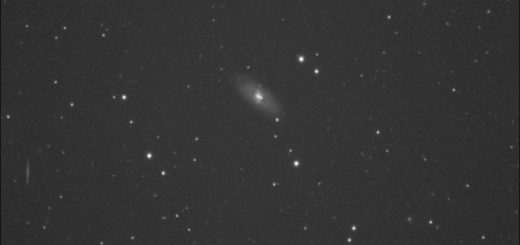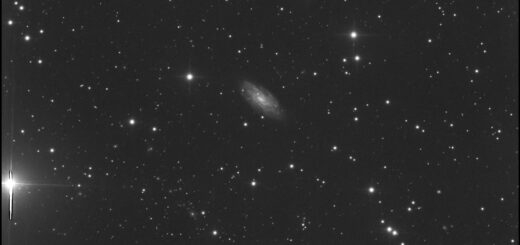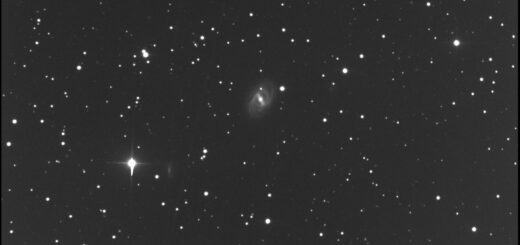
NGC 5981, NGC 5982 and NGC 5985: a stunning galaxy trio in Draco – 30 Apr. 2025.
We are pleased to share our image of the famous “Draco Triplet”, showcasing three as wonderful as different galaxies.
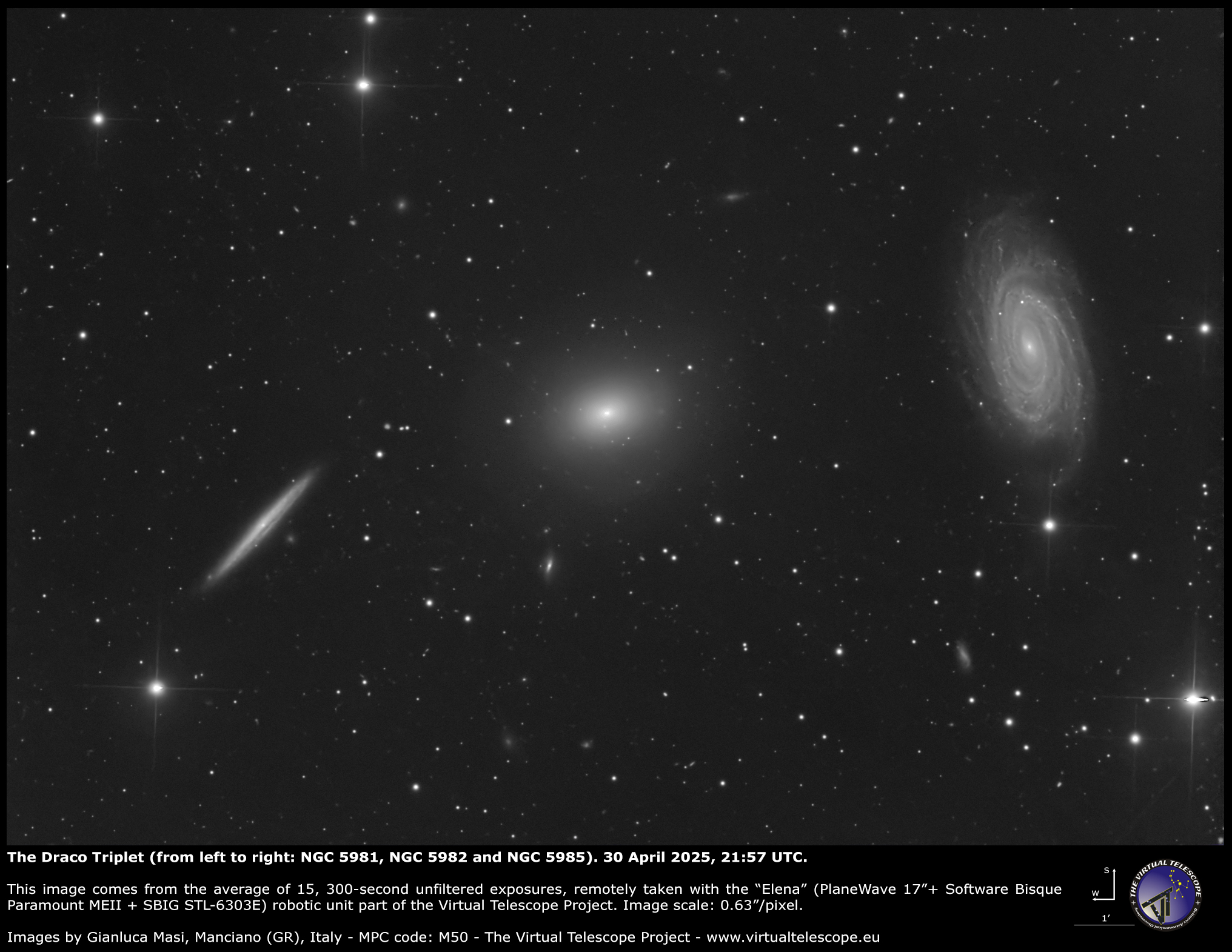
NGC 5981, NGC 5982 and NGC 5985: the Draco Triplet – 30 Apr. 2025.
The image above comes from the average of 15, 300-second exposures, remotely taken with the “Elena” (PlaneWave 17″ + Paramount MEII + SBIG STL-6303E) robotic unit available as part of the Virtual Telescope Project and installed in Manciano, Italy.
In the northern region of the sky, among the sinuous outlines of the constellation Draco, lies a small corner of the Universe where three galaxies appear to engage in a silent dialogue across cosmic time. This is the Draco Triplet, a celestial alignment that, from Earth’s perspective, brings together in a single field of view three galaxies of markedly different morphology: NGC 5981, NGC 5982, and NGC 5985.
NGC 5981, thin and elongated, is a spiral galaxy observed almost perfectly edge-on. Its spindle of light is crossed by a dark lane, carved by interstellar dust that absorbs the radiation of the stars lying behind it. This geometry offers astronomers a valuable opportunity to investigate the vertical structure of galactic disks and the distribution of interstellar matter.
At the center dominates NGC 5982, a massive and ancient elliptical galaxy. Its seemingly smooth appearance conceals a turbulent past: detailed observations reveal faint stellar shells, concentric arcs surrounding the nucleus. These are the remnants of ancient merger events: the fossil record of smaller galaxies accreted over billions of years. At its core resides a supermassive black hole, a silent witness to the system’s long evolution.
Completing the trio is the magnificent NGC 5985, a luminous barred spiral galaxy with a more open structure. Its graceful spiral arms wind around the nucleus, dotted with regions where active star formation is still ongoing.
Distance measurements place all three systems at roughly 130 million light-years from Earth; however, it remains uncertain whether these galaxies are truly bound by mutual gravitational interaction or whether their apparent proximity is merely the result of a chance line-of-sight alignment, that is a miracle of perspective.
Perhaps it is precisely this ambiguity that makes the Draco Triplet so compelling: a delicate balance between nearness and remoteness, between interaction and isolation.
NGC 5982 and NGC 5985 were discovered by William Herschel in 1788, while NGC 5981 was identified by George Stoney in 1850.
Support The Virtual Telescope Project!
Support us! Please, donate and celebrate the ARTEMIS II mission with an EXCLUSIVE and STUNNING digital hi-res image of the largest Supermoon of 2025 to download and frame on your wall and many more pictures, specifically made for supporters like you!