NGC 2419, the Intergalactic Wanderer: a view from our telescopes.
Among the most enigmatic objects inhabiting the Milky Way halo, the globular cluster NGC 2419 occupies a special place. We are pleased to release this inspiring image.

NGC 2419.
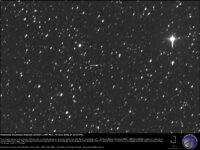
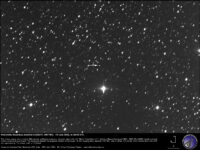
The image above comes from the average of 7, 300-second images captured last spring with the Celestron C14+Paramount ME+SBIG ST-10XME robotic unit available as part of the Virtual Telescope Project facility in Manciano, Italy.
Located in the constellation Lynx, at a distance exceeding 300,000 light-years from Earth, NGC 2419 is one of the most remote globular clusters known to belong to our cosmic metropolis.
Because of this extreme distance, it has been nicknamed the “Intergalactic Wanderer”, a designation that reflects its isolation and that was coined at a time when it was still debated whether such a distant object could truly be gravitationally bound to the Milky Way.
Discovered in 1788 by William Herschel, NGC 2419 appears as a compact, nearly spherical system composed of hundreds of thousands of very ancient stars, formed more than 12 billion years ago. These stars, markedly deficient in heavy elements, bear witness to a primordial epoch of the Universe, when matter had not yet been enriched by the nucleosynthetic products of successive stellar generations. As with other globular clusters, observing NGC 2419 therefore amounts to looking back in time, toward the earliest phases of the Milky Way’s formation.
What makes NGC 2419 particularly intriguing is its ambiguous nature. In terms of mass, size, and luminosity, it is significantly larger than the majority of globular clusters in our Galaxy. Some astronomers have suggested that it may represent the remnant nucleus of a former dwarf galaxy, subsequently disrupted by gravitational interactions with the Milky Way. If this interpretation is correct, NGC 2419 would constitute a genuine galactic fossil, a relic that survived an ancient episode of cosmic cannibalism.
Spectroscopic observations have furthermore revealed unusual chemical abundance patterns among its stellar populations, a feature that is difficult to reconcile with classical models of globular cluster formation. This anomaly continues to fuel active scientific debate.
Just east of the cluster, a very bright foreground star, HIP 37133, is visible. Its parallax indicates a distance of nearly 350 light-years, implying that the separation in distance between this star and NGC 2419 spans three orders of magnitude—a factor of one thousand—vividly illustrating the depth and vast extent of the Milky Way.
Isolated at the very outskirts of the Galaxy, NGC 2419 remains a fascinating and mysterious object: a sphere of light suspended in darkness, the silent custodian of the Universe’s most remote history.
Support The Virtual Telescope Project!
Support us! Please, donate and celebrate the ARTEMIS II mission with an EXCLUSIVE and STUNNING digital hi-res image of the largest Supermoon of 2025 to download and frame on your wall and many more pictures, specifically made for supporters like you!