When Eros Sweeps Past Andromeda: a Rare Sky Encounter Live on 30 November.
See (433) Eros, one the most important and largest near-Earth asteroids, crossing the field of view of the stunning Andromeda Galaxy from the comfort of your home.

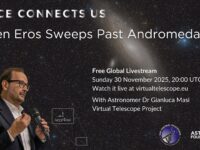
Visual of the event.
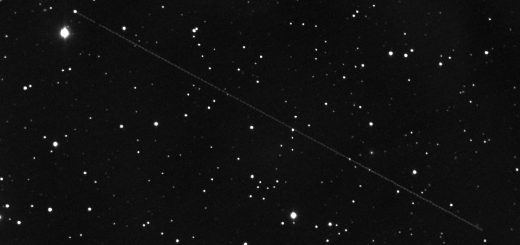
On 30th of November, the famous near-Earth asteroid (433) Eros – the first to be discovered in 1898 and one of the largest in its class — will fly at about 60 million kilometers from our home planet. While this is a considerable and completely safe distance, it nevertheless offers us the opportunity to easily observe this remarkable celestial body.
Thanks to its large size (34 × 11 × 11 kilometers), Eros will shine at around magnitude 10 for several weeks, making it easily observable even with a modest 60 mm telescope.
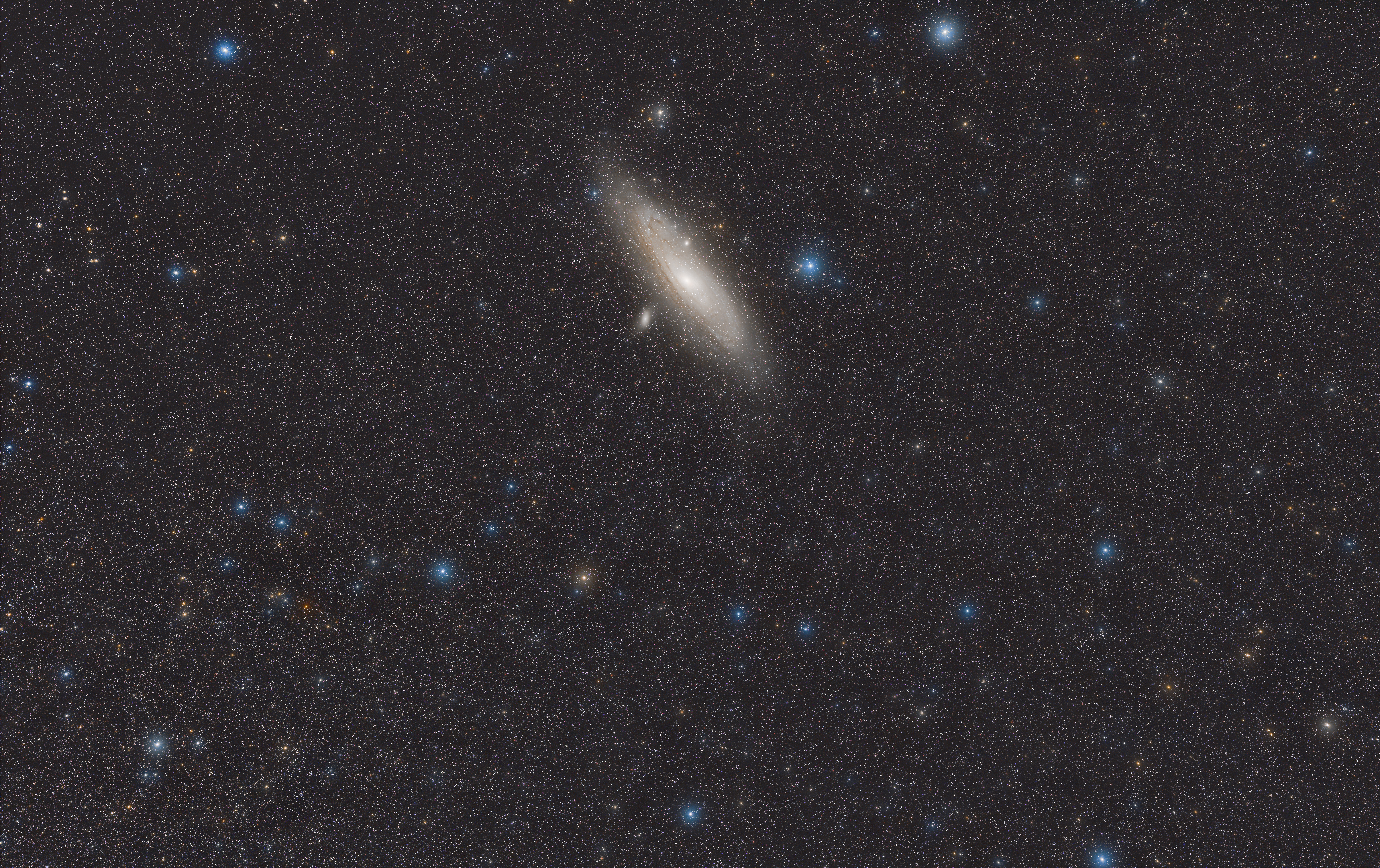
Making this opportunity even more valuable is the particular region of the sky the asteroid is currently crossing: it shines only a few degrees away from the legendary and spectacular Andromeda Galaxy, also known as Messier 31, the first galaxy to be recognized as external to our own and often considered the “elder sister” of the Milky Way.
In particular, right on the evening of November 30th, Eros will be just two degrees away from the core of that well-known cosmic island. Of course, this will be an apparent proximity, since the asteroid will be at “just” sixty million kilometers from us, while Messier 31 is two and a half million light-years away, more than twenty billions of billions kilometers.
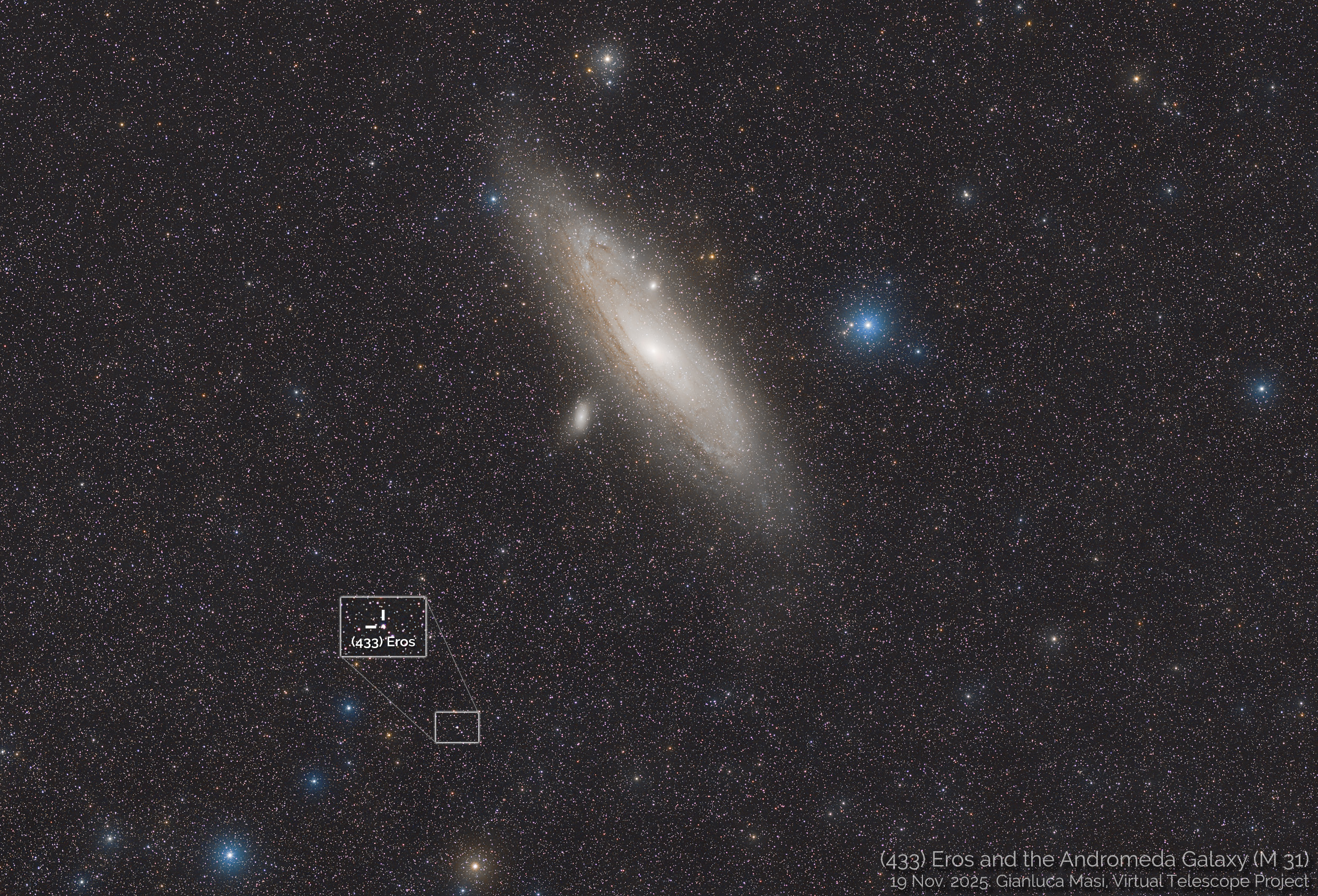
(433) Eros and the Andromeda Galaxy. 19 Nov. 2025.
(433) Eros was the first asteroid to be extensively studied on-site by a space probe orbiting around such an object: the NASA’s NEAR (Near Earth Asteroid Rendezvous) mission. The probe entered its orbit around Eros on February 14, 2000, and then descended onto its surface on February 28 of the following year.
The Virtual Telescope Project and the Asteroid Foundation will bring this show to the world live, sharing real-time images of (433) Eros moving less than two degrees away from our cosmic, largest neighbor.
The live streaming is scheduled for Nov. 30 and will start at 20:00 UTC. To join, just enter this page.
Please find below a media alert sharing all the details and the main points of this special, cosmic happening!
* MEDIA ALERT *
When Eros Sweeps Past Andromeda: A Rare Sky Encounter Live on 30 November
What: On the evening of 30 November, Near-Earth asteroid (433) Eros will pass just a couple of degrees from the bright core of the Andromeda Galaxy. The Virtual Telescope Project and the Asteroid Foundation will stream this striking alignment live to audiences worldwide.
When: 30 November 2025, 20:00 UTC
Where: on the virtualtelescope.eu website
Why it matters
Eros, one of the largest and best-known near-Earth asteroids, will be bright enough for small telescopes as it makes a safe flyby about (only) 60 million km from Earth. Its path brings it unusually close, in our sky, to Andromeda’s luminous centre. The result is a rare and highly photogenic pairing of a nearby asteroid with the most iconic galaxy beyond the Milky Way.
Key angles for media
- Striking visuals: Eros and Andromeda in the same field
- Broad public appeal and accessible science moment
- Expert commentary and interview availability
- Connection to the UN-sanctioned Asteroid Day initiative
- Useful background from NASA’s NEAR Shoemaker mission to Eros
- Broadcast-ready livestream footage
About the Virtual Telescope Project
Founded in 2006, the Virtual Telescope Project is a highly advanced facility consisting of several robotic telescopes installed in Italy and active in both scientific research and communication. Through its online observing sessions, it has broadcast many of the most remarkable astronomical events of the past twenty years, reaching millions of viewers around the world.
About the Asteroid Foundation
Founded in 2017 and based in Luxembourg, the Asteroid Foundation works to advance global understanding of asteroids—their scientific importance, the technologies that enable their exploration, and the relevance of planetary defence. The Foundation leads Asteroid Day, the annual United Nations–sanctioned outreach campaign held every 30 June and supported by scientists, engineers, space agencies and institutions worldwide. Through educational programmes, public events, school initiatives and partnerships with leading research organisations, the Foundation fosters curiosity, strengthens STEAM engagement and connects communities with the latest discoveries and opportunities in asteroid and space science.
Gianluca Masi, Astrophysicist, PhD
Gianluca Masi earned a degree in Physics (Astrophysics track) from the “Sapienza” University of Rome and completed a PhD in Astronomy at the “Tor Vergata” University. He has published more than 1,000 professional contributions, discovered dozens of asteroids and numerous variable stars, and is co-discoverer of three exoplanets as well as the transient ASASSN-15lh, one of the most luminous supernovae ever observed.
In 2006, he founded the Virtual Telescope Project. His scientific and photographic work regularly appears in major media outlets including ANSA, BBC, CNN, Newsweek, The New York Times, RAI and other national and international channels. He has delivered lectures worldwide. Asteroid (21795) Masi was named in his honour.
He serves as the national coordinator for Italy of Asteroid Day and is a member of the International Astronomical Union, the European Astronomical Society and the Italian Astronomical Society. An ambassador for the “Dark Skies for All” project, he has been awarded the Dark and Quiet Sky Protector certificate by the International Astronomical Union.
Contacts
Gianluca Masi, Virtual Telescope Project
Tel: +39 334 933690
Email: gianluca@bellatrixobservatory.org
Anna Bordus, Programme Director, Asteroid Foundation
Tel: +352 621 459 839
Email: anna.bordus@asteroidfoundation.org
Support The Virtual Telescope Project!
Support us! Please, donate and receive an EXCLUSIVE, hi-quality image of the record-setting 27 July 2018 total lunar eclipse above the Colosseum and many more pictures, specifically made for supporters like you!