The interaction galaxies NGC 4631 (the “Whale”), NGC 4656/57 (the “Hockey Stick”) and NGC 4627: an image – 21 Mar. 2026.
The “Whale” (NGC 4661) and the “Hockey Stick” (NGC 4656/57) are, with NGC 4627, a wonderful group of interaction galaxies: we are pleased to share here our image with you.
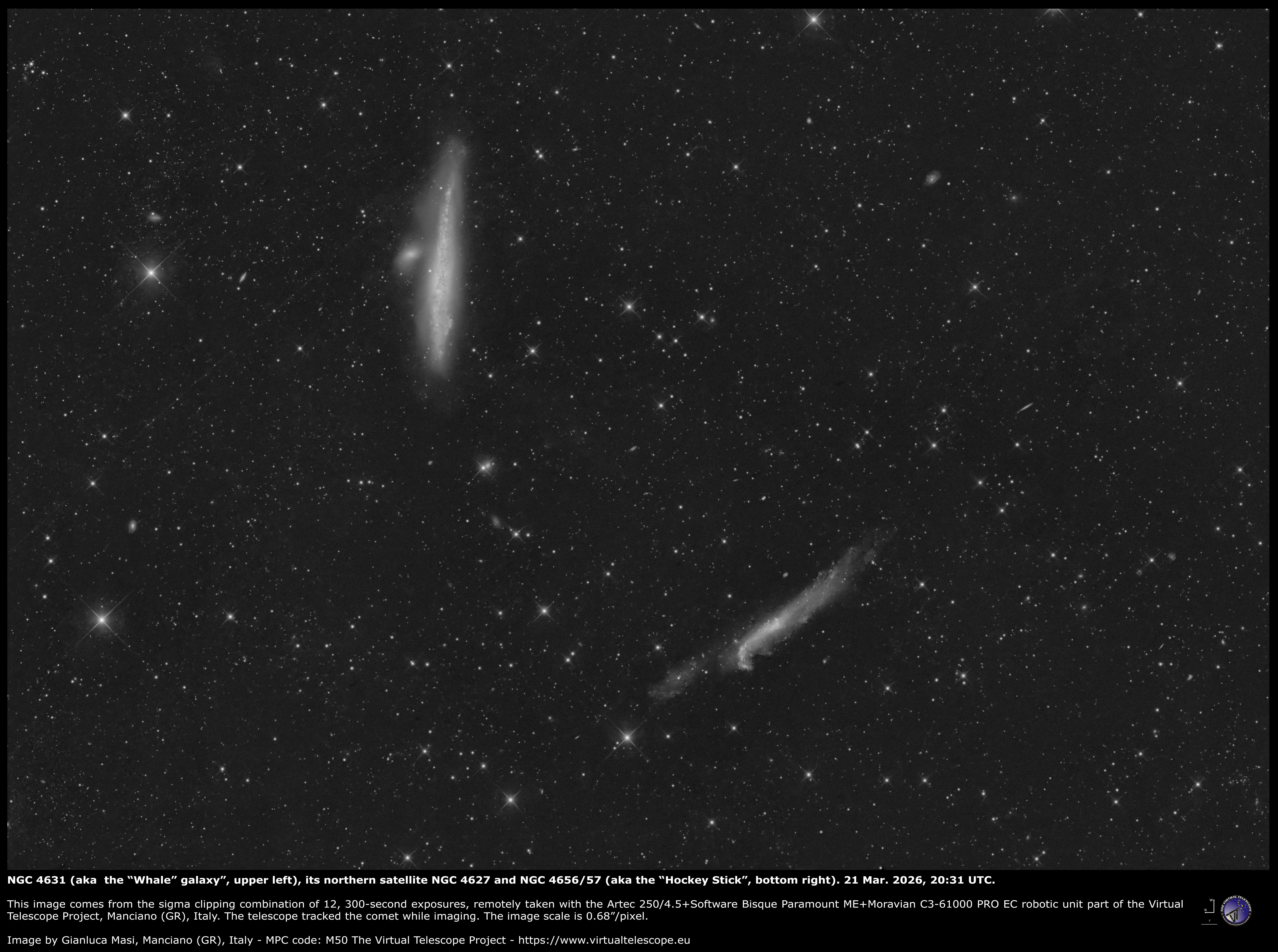
NGC 4631, NGC 4627 and NGC 4656/57.
The image above comes from the sigma-clipping combination of 12, 300-second exposures, remotely taken with the ARTEC250+Paramount ME+C3Pro61000EC robotic unit available as part of the Virtual Telescope Project facility in Manciano, Italy, under the darkest skies of the Italian peninsula.
In the deep silence of the cosmos, a small group of galaxies dances in a fragile and captivating balance: NGC 4631, NGC 4656, NGC 4657 and NGC 4627.
The two main structures, known respectively as the “Whale Galaxy” (NGC 4631) and the “Hockey Stick Galaxy” (NGC 4656), remind us of how dynamic, alive, and ever-changing the universe is.
NGC 4631 stretches out luminous and elongated, crossed by intricate webs of gas and dust that shine like veins of light in the cosmic darkness. Viewed edge-on, it reveals the full complexity of its star-forming regions and a diffuse halo that attests to the intense activity within. Right next to it lies NGC 4627, a compact elliptical dwarf galaxy, appearing discreet yet closely tied to the “Whale” through continuous gravitational interaction.
Adjacent to this system, NGC 4656 appears irregular and distorted, as if shaped by invisible forces. This deformation is further highlighted by NGC 4657, a brighter and more compact condensation standing out like a luminous knot: for some, a separate galaxy, for others a warped region of NGC 4656 itself.
The distance to these interacting galaxies is approximately 30 million light-years.
Perhaps this is the deepest charm of images like this: they remind us that we are part of a universe in constant motion, where even the most massive structures are not static, but evolve, brush past each other, and change. Four galaxies, one story: that of a cosmos that never ceases to create, transform, and amaze.
To the left of NGC 4631, near the edge of the image, a fairly bright star is visible; just above it, a tiny galaxy, SDSS J124147.30+325128.5, can be seen. All around, countless tiny island universes are evident, clearly part of a very distant cluster.
Support The Virtual Telescope Project!
Support us! Please, donate and celebrate the ARTEMIS II mission with an EXCLUSIVE and STUNNING digital hi-res image of the largest Supermoon of 2025 to download and frame on your wall and many more pictures, specifically made for supporters like you!