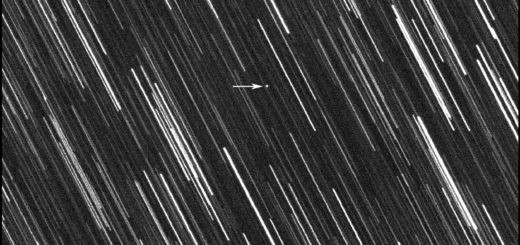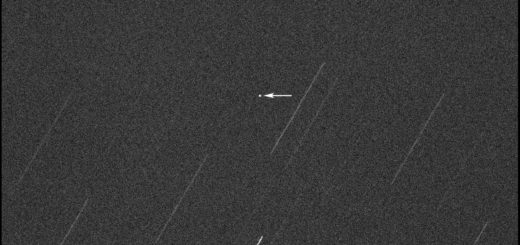
Potentially Hazardous Asteroid (152637) 1997 NC1 close encounter: an image, waiting for its spectacular flyby.
On 27 June 2026, the potentially hazardous asteroid (152637) 1997 NC1 will have a close, but safe encounter with our planet. Thanks to its important dimensions, it will be an easy target to observe: the Virtual Telescope Project will show it live, online.

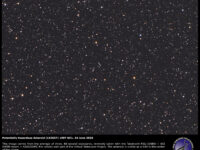
Potentially Hazardous Asteroid (152637) 1997 NC1: an image (17 May 2026)
On 27 June 2026, at 11:16 UTC, the potentially hazardous asteroid (152637) 1997 NC1 will make a close but safe approach to our planet, coming within 2.6 million kilometers — almost seven times the average distance to the Moon.
While this encounter is absolutely no cause for concern, it will be a very important and interesting opportunity: an asteroid of this size comes this close roughly once every ten years, becoming bright enough to be easily visible through small telescopes while it crosses the starry sky.
Discovered on 5 July 1997 by the NEAT survey, it has an estimated diameter between 710 and 1,600 meters. It belongs to the near-Earth asteroid population, being an Aten-type object (an Earth-crossing asteroid that spends most of its time inside Earth’s orbit), and it is also classified as a potentially hazardous asteroid because it is larger than about 140 meters and its orbit approaches that of Earth within 7.5 million kilometers.
“The upcoming flyby of (152637) 1997 NC1 will be truly remarkable”, says Gianluca Masi, astrophysicist, founder and director of the Virtual Telescope Project: “People will have the opportunity to see it visually through a small telescope or even good binoculars, particularly when it will peak in brightness on 28 June at 00:00 UTC, reaching magnitude 10.1”, he adds. “At that time, a modest 4-inch (100 mm) telescope will easily show it as it travel across the field of view” concludes dr. Masi.
At the time of its flyby, (152637) 1997 NC1 will be moving across the stars at a rate of about 40 arcseconds per minute, making it relatively easy to spot visually through a telescope.
In any case, the asteroid will remain brighter than magnitude 11.5 from 25 June to 1 July and during the same period it will move from Lyra (the Lyre), in the northern sky, to Norma (the Carpenter’s Square), in the southern hemisphere. The full Moon (29–30 June) will make it slightly harder to observe, but an 8-inch (200 mm) telescope will still easily show it visually.
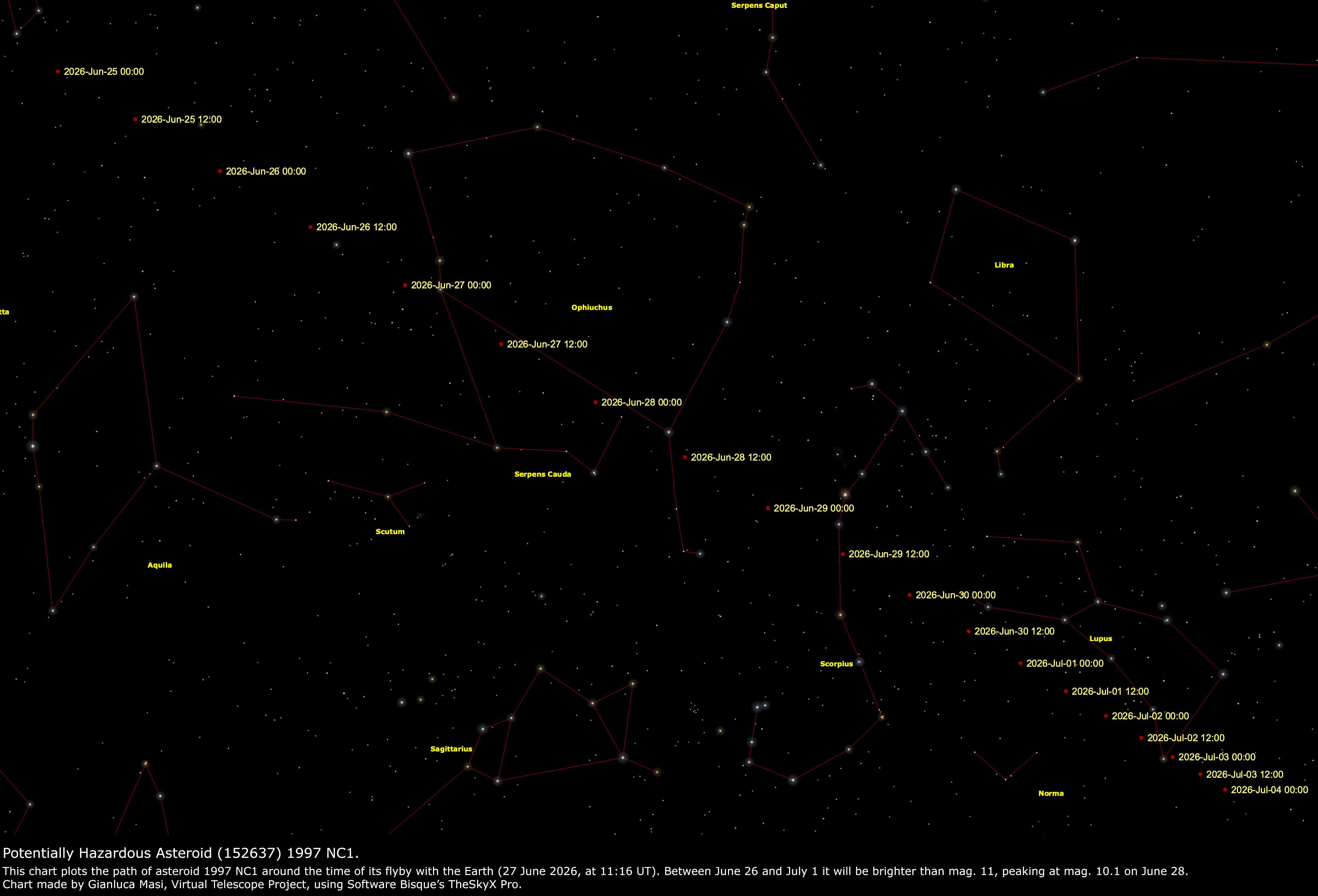
Potentially Hazardous Asteroid (152637) 1997 NC1: star chart showing its path in the sky.
Serendipitously, this flyby will occur just in time to celebrate Asteroid Day 2026, the United Nations-sanctioned day of public awareness of the risks of asteroid impacts, observed annually on 30 June. Asteroid (152637) 1997 NC1 will be an excellent target for public stargazing events.
The Virtual Telescope Project will broadcast the potentially hazardous asteroid (152637) 1997 NC1 live on 26 and 27 June, both feeds starting at 23:00 UTC, with the commentary of astrophysicist Gianluca Masi. To join remotely, visit the Virtual Telescope Project website at www.virtualtelescope.eu
Support The Virtual Telescope Project!
Support us! Please, donate and celebrate the ARTEMIS II mission with an EXCLUSIVE and STUNNING digital hi-res image of the largest Supermoon of 2025 to download and frame on your wall and many more pictures, specifically made for supporters like you!